
EBENEZER: The Things We Forget

Before You Read
This reflection isn't intended to be rushed. You may find yourself pausing over a sentence, returning to a particular thought or simply sitting quietly with the Scriptures before continuing. Give yourself permission to do that. My hope isn't simply that you reach the end of these pages, but that somewhere along the way you are reminded of the faithfulness of God and find yourself drawing a little closer to Him.
The Things We Forget

This week, as I prepared to preach for Holy Communion, I found myself spending much longer in one passage of Scripture than I had intended. I wasn't looking for a new idea or trying to find a different way of approaching Communion. I simply opened my Bible expecting to prepare a sermon, yet the more time I spent with the passage, the more I realised that God wasn't simply preparing me to preach.
He was quietly reminding me of something that I needed to remember for myself.
I have often found that this is one of the beautiful ways God teaches us. There are passages of Scripture that we return to time and time again, believing we already understand them, only to discover that they seem to reveal something completely different because we are no longer the same person we were the last time we read them.
The words on the page have not changed, yet somewhere within our own journey God has been shaping us, healing us and gently opening our eyes to truths that were always there but that we simply were not ready to see before.
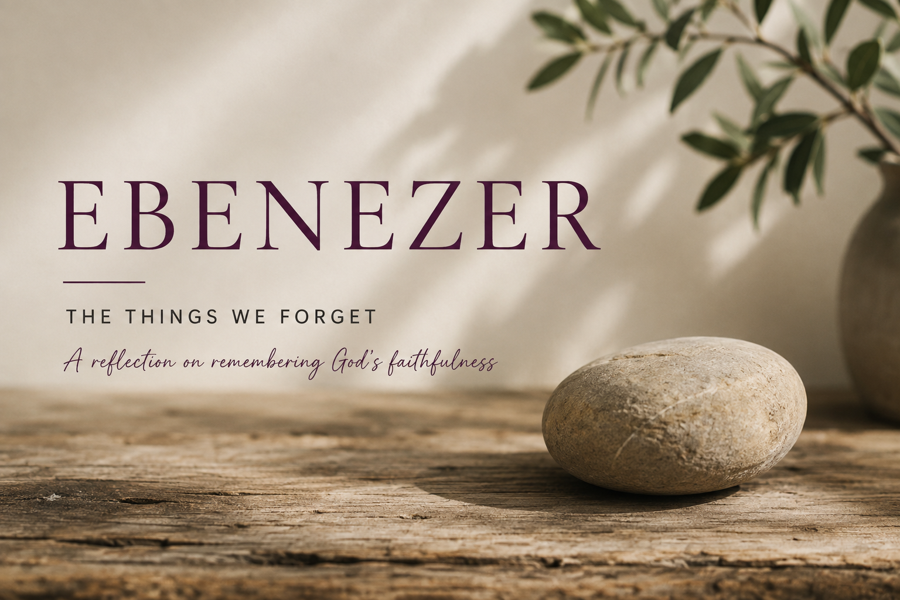
That was my experience as I sat with the story of Samuel and the stone he called Ebenezer.
It is such a small moment within a much bigger story that it would be very easy to read past it. Israel had experienced God's deliverance, the enemy had been defeated and the immediate danger had passed, yet instead of allowing everyone to celebrate and continue with life, Samuel stopped. He bent down, picked up a stone, placed it between Mizpah and Shen and gave it a name:
"Ebenezer."
Thus far the Lord has helped us."
Remembering Shapes the Way We Live
God doesn't only ask His people to trust Him. Throughout Scripture He continually asks them to remember Him. The invitation to remember has always been for our benefit, because remembering has a remarkable way of shaping the way we see both our present circumstances and our future. When we intentionally remember the faithfulness of God, hope begins to grow again, gratitude softens weary hearts and we recognise that the God who carried us yesterday has not changed simply because today feels different.
As I continued sitting with that thought, I realised that remembrance doesn't end with the Old Testament. The memorial stones, the feasts and the festivals all taught God's people to look back and remember His faithfulness, yet they were also pointing towards something greater. They prepared the way for the day when Jesus Himself would give His followers a new act of remembrance, one that would no longer point to a single moment in Israel's history but to the cross, where God's greatest act of love would be revealed.
Jesus Gave Us Himself
Samuel gave Israel something they could look at. Jesus gave His Church something they could participate in.
Samuel's stone pointed back to one moment in Israel's history when God had acted on their behalf. The Lord's Table also looks back, but it does something more. Every time we break the bread and share the cup, we proclaim the death of Christ until He comes again. Communion remembers the cross, anchors us in the present reality of Christ's grace and points us towards the hope of His return. It holds together what God has done, what He is doing and what He has promised still to do.
Ebenezer marked God's victory over the Philistines, but the cross declares God's victory over sin and death. Samuel's stone became a reminder that God had intervened on behalf of His people at a particular moment in history. The cross stands as the everlasting reminder that, through Christ, God has dealt with the greatest enemy we could never overcome ourselves. Every celebration of Holy Communion draws us back to that finished work, reminding us that our hope rests not in our own faithfulness but in His.
Every time we gather around the Lord's Table we are invited to stop, remember and receive again the reminder of His love and faithfulness. Communion is not simply about looking backwards. It reminds us that Christ is still present with us today and that our hope rests in Him.
Walking Away from the Table
Remembrance is not about remaining in the past. It is about allowing the faithfulness of God in yesterday to strengthen our trust in Him today and our confidence for tomorrow. As we continue our journey we carry with us the assurance that the God who has helped us thus far will remain faithful in every season still to come.

A Moment to Reflect
• Where have I seen God's faithfulness in this season of my life?
• Which answered prayers have quietly become forgotten blessings?
• If I were to build an Ebenezer today, what would it represent?
Take time to sit with the Lord, thank Him for His faithfulness and allow gratitude to grow again.

An Invitation to the Table
This reflection began with Samuel placing a stone so that the people would remember the faithfulness of God. It ends at another place of remembrance, not around a stone, but around the table of Christ.
Jesus knew that we would need reminding just as much as Israel did. He knew that life would become busy, that our hearts would become weary and that we would sometimes forget the depth of His love. That is why He invited His disciples to keep coming back to the table, not as a ritual to complete, but as a place to remember.
If you know Jesus, I would encourage you to take a few quiet moments today to receive Holy Communion. You do not need a church service or a special occasion. Simply take some bread and a cup, read 1 Corinthians 11:23–26 slowly, and allow your heart to rest once again in the finished work of Christ.
As you eat the bread, remember His body, broken for you.
As you drink from the cup, remember His blood, poured out for you.
Then, before you continue with the rest of your day, pause for one final moment and thank Him.
Not only for what He has done.
Not only for what He is doing.
But because, through every season of your life, His faithfulness has never failed.
May Samuel's words become your own quiet testimony today:
"Thus far the Lord has helped us."




Comments