
When the Moment Finally Arrives | Part 5


There comes a point in Esther’s story where everything begins to shift, and the quietness of the earlier chapters gives way to a moment that now requires a response.
By the time we reach Esther chapter four, we have already seen enough of her story to know that this moment has not arrived in isolation. Esther has lived through loss, hiddenness, preparation, restraint and life within a palace system she did not create. She has carried an identity that could not yet be fully revealed, and she has had to learn how to live faithfully in a place where so much of her story remained unseen.
Now, however, the story begins to move differently.
Haman’s decree has gone out, and the Jewish people are under threat. Mordecai sends word to Esther, and suddenly her position in the palace is no longer just part of her own personal story. It carries responsibility for others.
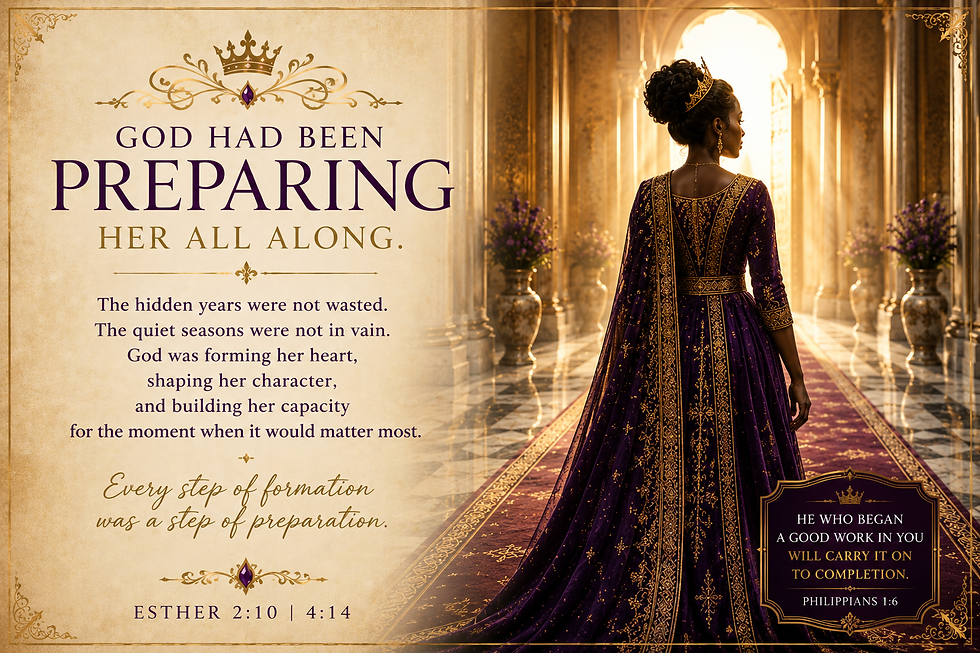
Mordecai’s words have echoed throughout history:
“Yet who knows whether you have come to the kingdom for such a time as this?”
Esther 4:14 NKJV
These words are often quoted when people speak about purpose, but I think they carry something much deeper than simply encouraging us to chase destiny or step into a great moment. Mordecai is not flattering Esther, and he is not making her the centre of the story. He is helping her recognise that her position now carries responsibility, and that the life she has been living quietly may now require a costly response.
What strikes me is that Esther does not immediately rush into action. She understands the seriousness of what is being asked of her, and she names the reality of the risk before her. Entering the king’s presence uninvited could cost her life unless the king extended the golden sceptre, so this was not simply a bold conversation or a courageous speech. It was an act that required surrender.
That is something I have found deeply challenging.
Sometimes we imagine that once God has been preparing us, the next step will feel clear, easy and full of confidence. Yet Esther reminds us that being prepared by God does not mean we will never feel afraid. It means there is a deeper place from which we can respond when fear is still present.
I have often thought about courage in that way. It may not always be the absence of fear. Sometimes courage is choosing obedience while fear is still in the room.
There have been moments in my own life where I have sensed God asking me to take a step that felt uncomfortable, not because I doubted Him, but because I was aware of my own limitations. Sometimes obedience asks us to leave what feels safe, sometimes it asks us to have difficult conversations, and sometimes it asks us to trust God before we can see the outcome.
Like Esther, we rarely receive every answer before taking the first step.

One of the things I love most about this chapter is that Esther does not try to carry the burden alone. Before she goes before the king, she asks others to fast with her.
“Go, gather all the Jews who are present in Shushan, and fast for me...”
Esther 4:16 NKJV
That detail matters because Esther’s courage was not rooted in self-confidence. Before there was public movement, there was private surrender. Before there was action, there was dependence. Before Esther stepped forward, she recognised her need for God and invited others to stand with her in that place of fasting.
That challenges the part of us that wants to appear strong all the time.
We live in a culture that often celebrates independence, but Scripture continually reminds us that God’s people were never intended to walk alone. There is wisdom in inviting others to pray. There is strength in recognising that we need God. There is humility in admitting that we cannot carry every responsibility by ourselves. presented as passive resignation, but as active trust. It is the place where dependence deepens, where our confidence becomes rooted in God rather than our own ability to make things happen, and where we learn that obedience is not measured by speed but by faithfulness. One of the things I love most about this chapter is that Esther does not try to carry the burden alone. Before she goes before the king, she asks others to fast with her.
“Go, gather all the Jews who are present in Shushan, and fast for me...”
Esther 4:16 NKJV
That detail matters because Esther’s courage was not rooted in self-confidence. Before there was public movement, there was private surrender. Before there was action, there was dependence. Before Esther stepped forward, she recognised her need for God and invited others to stand with her in that place of fasting.
That challenges the part of us that wants to appear strong all the time.
We live in a culture that often celebrates independence, but Scripture continually reminds us that God’s people were never intended to walk alone. There is wisdom in inviting others to pray. There is strength in recognising that we need God. There is humility in admitting that we cannot carry every responsibility by ourselves.

When Esther finally says,
“If I perish, I perish.”
Esther 4:16 NKJV
she is not speaking from despair. She is speaking from surrender.
Those words are not about giving up. They are about entrusting herself completely to God. Esther does not know how the king will respond, and she does not know what the outcome will be, but she chooses obedience because the moment requires more than self-preservation.
I wonder whether this is what mature faith often looks like.
Not certainty about every outcome, but confidence in the One who holds the outcome.
As I have reflected on this chapter, I have realised that the defining moments of our lives are rarely created in the moment itself. They often reveal what has been shaped within us through the quieter years that came before.
When Esther reaches this point in the story, she is not becoming someone entirely new. What has been forming quietly now begins to find expression in a public and costly way.
I think that is true for many of us as well.
When the moment finally arrives, we may discover that God has been preparing us for far longer than we realised. The years were not wasted, the waiting was not pointless, and the hidden work was not forgotten. God had been shaping the person long before the assignment became clear.
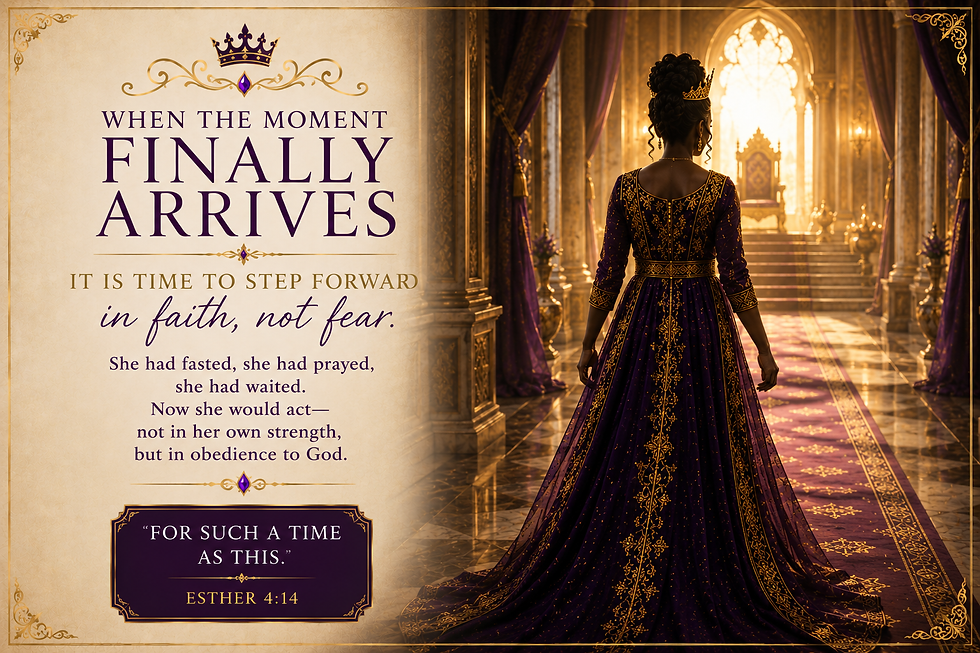
Esther’s story reminds us that God often prepares His people before He calls them to act. Yet it also points us beyond Esther herself. The courage we admire in her ultimately leads us to Christ, who did not simply risk His life for His people, but willingly gave it.
Esther approached an earthly king not knowing whether mercy would be extended, but through Christ, we are invited to approach the throne of grace with confidence because mercy has already been secured.
That is where our courage ultimately rests.
It does not rest in ourselves, our readiness, or our ability to control what happens next. Our courage rests in Christ, who has gone before us, who remains with us, and who strengthens us by His Spirit for the obedience He asks of us.
So when the moment finally arrives, we do not have to pretend we are fearless. We do not have to perform confidence we do not feel. We can come honestly before God, seek His help, invite others to pray with us, and take the next faithful step, trusting that the One who formed us in hiddenness will also sustain us in obedience.

Take a Moment to Reflect
Is there an area of my life where God may be asking me to take a step of obedience?
Am I waiting until I feel fearless, or am I willing to trust God while I still feel uncertain?
How has God been preparing me through the hidden seasons that came before today?
Who can I invite to pray with me as I walk through this season?
What might faithfulness look like in the situation I am facing right now?
Prayer
Father,
Thank You for every hidden season You have used to prepare my heart.
Thank You that You have never wasted the waiting, the healing, the questions or the quieter chapters of my life.
Help me not to shrink back when You call me to step forward.
Give me courage that is rooted in trust rather than confidence in myself. Teach me to depend upon You, to seek wisdom from others, and to remember that You have been preparing me long before I recognised the moment.
Like Esther, help me to place my life into Your hands, trusting that whatever You ask of me, Your grace will be enough.
May I walk in humility, obedience and faith, knowing that You remain faithful in every season.
In Jesus’ name, Amen.
Further Reflections from Esther
This reflection forms part of the Lessons from the Life of Esther series.
Still to come:
• For Such a Time as This
As I have continued sitting with Esther's story, I have found that there is always more to see. My prayer is that these reflections encourage you to trust God's timing, remain faithful in every season, and recognise that even the quieter chapters of life are held securely within His sovereign purposes.



Comments