
Who Are You When the Activity Slows Down?|Part 4


As I continued sitting with Esther's story, I found myself drawn to a part of the narrative that can so easily be overlooked. We often move quickly from Esther's hiddenness to the courage of chapter four, yet between those moments the pace of the story becomes much quieter.
The drama settles, life carries on, and what follows appears remarkably ordinary. Mordecai continues sitting faithfully at the king's gate, Esther continues living within the palace, and there is little to suggest that one of the most significant moments in Israel's history is quietly drawing nearer.
Then we read that Mordecai overhears a plot against the king. He tells Esther, Esther informs the king in Mordecai's name, the matter is investigated, and the event is carefully recorded in the royal chronicles. After that, the story simply continues. There is no immediate reward, no public recognition, and no indication that anything extraordinary has taken place.
As I sat with these verses, I found myself wondering whether this is one of the most familiar places for many of us to live, not in the defining moments or the dramatic chapters, but in the quieter spaces in between.
These are the seasons where life carries on, the activity slows, and we quietly continue walking with God without knowing what He is preparing next.
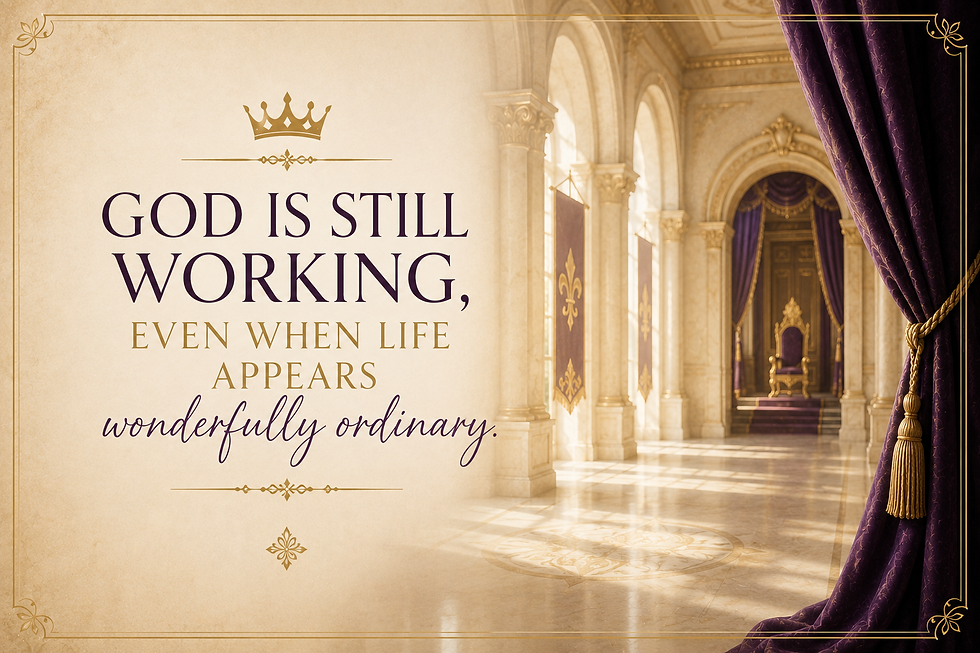
I think that can be one of the most unsettling places in the Christian life.
We naturally like movement. We like to know what God is doing, where He is leading us, and what comes next. We find comfort in open doors, visible opportunities, and clear direction. Yet there are seasons when the Lord asks us to remain faithful without immediately revealing the next chapter.
It may be that waiting is never simply about time, because waiting is often about trust.
When we read Esther, we know what is coming because we have the privilege of reading the whole story.
We know there will be a Haman, we know there will be a banquet, we know there will be a moment when Esther will stand before the king and risk everything for the sake of her people.
Esther knew none of that, she simply lived the life God had placed before her, continuing to walk faithfully in the season she had been given without knowing how God would one day weave those ordinary days into His greater purposes.

As I reflected on this, I realised how much it echoed my own journey, there was a time when the deepest work of healing had begun. Therapy had become part of my life, the Lord had untangled so much within me, my understanding of myself had changed, and I knew I could no longer live as I once had.
Yet, after all of that formation, life did not suddenly become busy again. There was no dramatic arrival, no immediate platform, and no sudden sense that everything had fallen into place. Instead, I found myself learning how to live as the person God had been forming, and that proved to be a very different journey.
For years I had measured faithfulness by activity, I had been used to serving, helping, carrying responsibility, filling gaps, and responding to need. Now I had to learn that faithfulness could also look quiet. It could look like living within new boundaries, embracing a different pace, and trusting that I did not have to force the next season into existence.
Looking back now, I realise that God was teaching me how to inhabit the life He had formed within me. It may be that this is one of the reasons Scripture speaks so often about waiting upon the Lord.
Waiting is never presented as passive resignation, but as active trust. It is the place where dependence deepens, where our confidence becomes rooted in God rather than our own ability to make things happen, and where we learn that obedience is not measured by speed but by faithfulness.

The remarkable thing about Esther is that God's name is never mentioned, yet His providence quietly fills every chapter. He is working through conversations, timing, faithful obedience, and ordinary days that appear almost insignificant. Nothing seems spectacular, yet everything is moving according to His purposes.
We naturally want God to tell us what comes next because clarity makes us feel secure. Yet the Lord often gives us enough light for today's obedience while asking us to trust Him with tomorrow. It may be that faith has never been about knowing the whole journey; it has always been about walking with the One who does.
That does not mean waiting is easy.
There are days when we wonder whether we have misunderstood God's leading. There are moments when we question whether we have missed an opportunity or taken a wrong turn. Watching other people move into new seasons can leave us wondering why our own story seems to have become so quiet.
Yet Esther gently reminds us that quietness should never be confused with God's absence.
The same God who was quietly ordering events behind the scenes while Esther simply lived faithfully in the season she had been given, is the same God who continues to work in ways we cannot always recognise. His providence is never hurried, and His purposes are never delayed.
Looking back over my own life, I can see that some of the greatest changes did not happen because I forced a door open. They happened because, slowly and often reluctantly, I learned to stop forcing what only God could unfold in His own time.
There was a time when I thought faithfulness meant saying yes to every opportunity, carrying every responsibility, and filling every gap I could see. I genuinely believed I was serving the Lord. Yet, as He continued His work within me, I realised that maturity is not measured by how much we can carry, but by how closely we are walking with Christ.
Sometimes obedience means stepping forward, and sometimes it means waiting. Sometimes it means speaking, and sometimes it means remaining silent.
Wisdom is learning the difference.

I think that is what I see growing within Esther, is that she is no longer striving to become someone. She is simply learning to live faithfully as the person God has already been forming.
There are seasons when God asks us to live quietly, faithfully, and without knowing what comes next. Those seasons are not empty, and they are certainly not wasted. More often than not, they become the place where trust grows deeper than certainty, where faith becomes steadier than feelings, and where our confidence rests less in having all the answers and more in the God who already holds them.
When I look again at Esther, I am struck by the fact that she had no idea what lay ahead. She did not know that one day she would stand before the king to plead for the lives of her people, she simply remained faithful in the season she had been given. It may be that this is one of the greatest lessons this quieter part of Esther's story offers us.
Faithfulness is not only about how we respond when the defining moment finally arrives. Faithfulness is also found in the ordinary days beforehand, when life feels quieter, when the next chapter has not yet unfolded, and when obedience simply looks like continuing to walk with God one day at a time.
If you find yourself in one of those quieter seasons, do not mistake it for God's absence. He has not forgotten you, and He has not misplaced His purpose for your life. The God who quietly ordered Esther's story is quietly ordering yours.
There will be a moment when the Lord says, "Now."
Until then, may we have the grace to remain faithful in the season we have been given, trusting that the God who forms us is also the God who knows exactly when the time is right.

Take a Moment to Reflect
• Am I tempted to measure my faithfulness by how busy or visible I am?
• Have I been trying to rush into a new season before fully embracing the one God has me in now?
• What has God been teaching me during this quieter season that I may have overlooked?
• In what areas is the Lord inviting me to trust Him more deeply, even though I cannot yet see what comes next?
Prayer
Father,
Thank You that Your purposes are never hurried and that Your timing is always perfect. Forgive me for the times I have mistaken quiet seasons for forgotten seasons, or believed that You were absent simply because life had become still.
Help me to remain faithful in the ordinary days, to trust You when the path ahead is not yet clear, and to rest in the assurance that You are always at work, even when I cannot yet see what You are preparing.
Teach me to walk at Your pace rather than my own. Give me the wisdom to embrace the season You have entrusted to me, the courage to remain obedient when life feels quiet, and the faith to believe that every step of surrender is preparing me for whatever You have planned ahead.
May my confidence rest, not in knowing what comes next, but in knowing You.
In Jesus' name,
Amen.
Further Reflections from Esther
This reflection forms part of the Lessons from the Life of Esther series.
Still to come:
• When the Moment Finally Arrives • For Such a Time as This
As I have continued sitting with Esther's story, I have found that there is always more to see. My prayer is that these reflections encourage you to trust God's timing, remain faithful in every season, and recognise that even the quieter chapters of life are held securely within His sovereign purposes.



Comments