
For Such a Time as This | Part 6


As I have continued sitting with Esther's story, I have found myself returning again and again to the words we often remember most. They are powerful words, but they are also words we have to handle carefully because it is easy to read this verse as though it is simply about personal destiny, as though Esther's story exists only to remind us that we each have a great moment waiting for us.
Yet, as I have reflected on Mordecai's words, I have become increasingly convinced that this is not really the heart of what he is saying. He is not flattering Esther, nor is he inviting her to see herself as the centre of the story. Instead, he is gently reminding her that God's purposes have always been bigger than one person. Although Esther has been positioned by God, she is not the source of deliverance. She has influence, but she is not in control of the outcome, and although she has access to the palace, the preservation of God's people does not ultimately depend upon her power.
That is what makes Mordecai's next words so significant.
"Yet who knows whether you have come to the kingdom for such a time as this?"
Esther 4:14 (NKJV)

Those words have completely reshaped the way I have come to understand the phrase, "for such a time as this." The more I have sat with them, the more I have realised that calling is not about becoming indispensable to God. It is about being invited to participate in what He is already doing. Esther's obedience mattered, but God's faithfulness was never fragile. His purposes did not begin with Esther, nor would they end with her. Yet, in His grace, He chose to invite her into the story He was already writing.
As I have reflected on this, I have come to realise that this is one of the greatest lessons the book of Esther teaches us. We often spend time asking what God's plan is for our lives, yet the book of Esther gently reminds us that God has always been working on a much bigger canvas than our own individual story. Esther was not called simply to fulfil her potential or discover her purpose. She was invited to participate in God's unfolding work of redemption, and her obedience mattered not because everything depended upon her, but because God, in His grace, had chosen to involve her in what He was already accomplishing.
I think that is such a helpful reminder for us today because we live in a culture that often encourages us to place ourselves at the centre of every story. We naturally ask what God wants to do for us, where He is leading us, or what purpose He has for our lives. While those are not wrong questions, I wonder whether the book of Esther quietly invites us to ask another.
Where is God already at work, and how might He be inviting me to participate?
There is something wonderfully freeing about that question because it reminds us that the pressure is not on us to make God's purposes happen. We are not responsible for holding His plans together. Instead, we are simply invited to walk faithfully with Him, trusting that He is accomplishing far more than we can see.

As I have continued reflecting on Esther, I have realised that this has quietly reshaped the way I look at my own life. There have been seasons that made very little sense while I was living through them. Times of grief, years of healing, therapy, ministry, waiting, disappointment, study, prison ministry and unexpected joy all felt like separate chapters, each demanding my attention at the time.
Looking back now, however, I can see that they were never isolated experiences. God was patiently weaving them together into a story that I could not yet understand. At the time, I could only see the thread I was holding, but God could already see the whole tapestry.
Perhaps that is one of the reasons the book of Esther has spoken to me so deeply. God's name is never mentioned, yet His fingerprints are on every chapter. He is quietly arranging circumstances, positioning people, opening doors, restraining evil and fulfilling His promises, often without anyone fully recognising what He is doing until much later.
As I have sat with Esther's story, I have found that deeply reassuring because it reminds me that God's faithfulness is not dependent upon my ability to recognise His hand in every moment. He is still at work, even when I cannot yet see the whole picture.
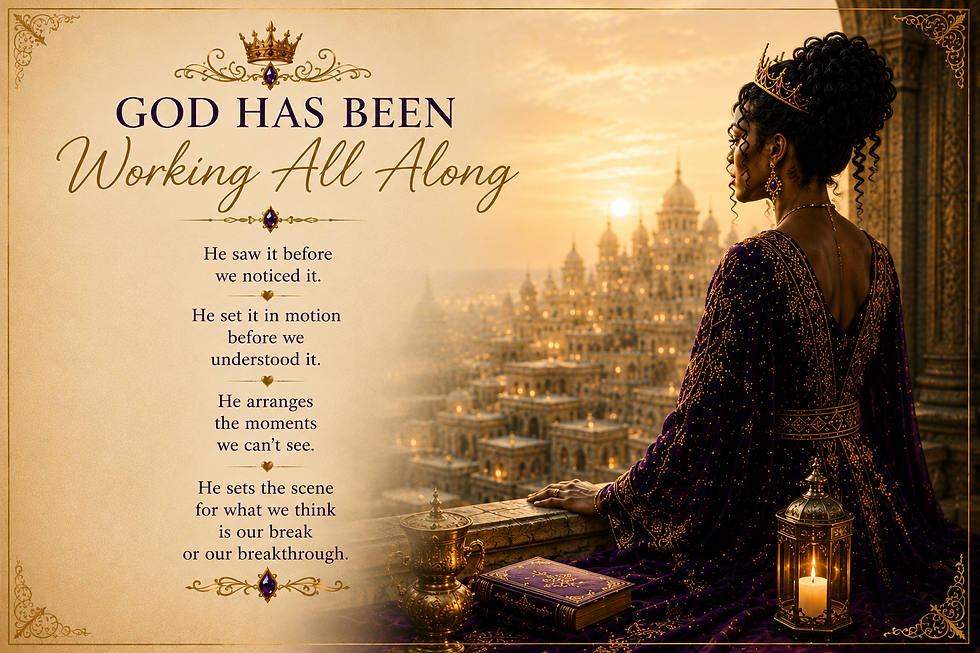
I wonder whether that is true of our own lives as well. There may be chapters that feel confusing today, conversations we do not yet understand, losses we cannot yet explain, or delays that seem to make very little sense.
We may find ourselves asking questions that remain unanswered or wondering why God appears to be silent. Yet the same God who was faithfully writing Esther's story is faithfully writing ours, and He is no less present simply because we cannot yet see what He is doing.
That thought has brought me great peace over the years because it has reminded me that I do not need to understand every chapter in order to trust the Author who is writing the story.
Faith does not always come from having the answers; sometimes it grows as we learn to trust the One who already sees the beginning, the middle and the end.

As I have journeyed through Esther over these past weeks, I have found myself returning to one truth more than any other. It is not simply that God has a purpose for our lives, nor even that He is able to position people at exactly the right moment. Rather, it is that He is faithful from beginning to end.
He is faithful in the chapters where His hand seems obvious, and He is faithful in the chapters where His presence appears hidden. He is faithful when His people are waiting, faithful when they are praying, faithful when they cannot yet see how the story will unfold, and faithful when the defining moment finally arrives.
Perhaps that is why the book of Esther has continued to speak so powerfully to the Church. Although God's name is never mentioned, His faithfulness is woven into every page. He is present in the ordinary conversations, in the unexpected delays, in the sleepless nights, in the courage of ordinary people and in the quiet unfolding of events that, at first, seem to have little significance. It is only when we reach the end of the story that we begin to realise He has been present all along.
Yet even then, Esther's story does not ultimately leave us looking at Esther.

Like so many people throughout Scripture, her life quietly points beyond itself to someone greater. Esther was willing to risk her life as she stood before an earthly king, hoping that mercy would be extended to her people. Jesus did not simply risk His life; He willingly laid it down so that all who trust in Him might receive mercy, forgiveness and eternal life.
Esther approached the throne unsure of what awaited her. Because of Christ, we are invited to approach the throne of grace with confidence, knowing that mercy has already been secured through His death and resurrection. The faithfulness we catch glimpses of throughout the book of Esther is fully revealed in Jesus Christ, for He is the greater Deliverer, the faithful King and the One in whom every promise of God finds its fulfilment.
Perhaps that is the greatest lesson Esther leaves with us.
Our lives make far more sense when we view them through the faithfulness of God than through the circumstances we happen to be living in today. We may not always understand the chapter we are in, but we can trust the Author who is writing the story, knowing that the One who was faithful to Esther remains faithful still.

As I come to the end of this journey through Esther, I find myself feeling less captivated by Esther herself and more captivated by the God who was faithfully at work throughout her story. Although her courage rightly inspires us, it is God's faithfulness that has remained with me long after I have closed the pages of this remarkable book.
Esther reminds us that God is often accomplishing far more than we are able to recognise in the moment. There are seasons that feel hidden, prayers that seem unanswered, delays that leave us wondering what He is doing, and chapters that appear disconnected from everything that came before. Yet time and again, the book of Esther gently reminds us that God has never stopped working, even when His hand has seemed hidden from view.
I think that is a truth I will continue to carry with me long after this series has finished. It has encouraged me to hold my own story with a little more patience and a little more trust, recognising that I do not need to understand every chapter while I am living it. My responsibility is not to write the story, but to walk faithfully with the Author who already knows how every chapter belongs together.
Perhaps that is the invitation Esther leaves with each one of us. Not simply to admire her courage, but to trust the God who gave her courage. Not simply to look for our own "such a time as this" moment, but to recognise that every season presents an opportunity to respond faithfully to the God who is already at work around us.
Whether we find ourselves in a season of waiting or a season of action, in hiddenness or in greater visibility, in joy or in disappointment, the invitation remains the same. We are invited to trust the God who has always been faithful, to participate in what He is already doing, and to leave the outcome safely in His hands.
Perhaps that is why Esther's story continues to resonate so deeply. It reminds us that while we rarely understand the whole story as we are living it, we can trust the One who does.

Take a Moment to Reflect
As we come to the end of Esther’s story, I wonder what has stayed with you most. It may be her courage, God’s quiet providence, or the reminder that He is often working in ways we cannot yet see. Whatever it is, I hope these reflections encourage you to continue sitting with the story and allowing it to shape your own walk with God.
As I look back over my own life, where can I now recognise God’s faithfulness, even though I could not always see it at the time?
Is there a season I once thought was wasted that God may actually have been using to form me?
Am I trying to write my own story, or am I learning to trust the Author who is writing it?
Where might God already be at work, and how could He be inviting me to participate in what He is doing?
How has Esther’s story helped me see Jesus, and what does that mean for the way I live today?
Prayer
Father,
Thank You for Your faithfulness through every season of my life. Thank You for the hidden years, the waiting, the joy, the sorrow, the questions, and even the moments when I could not see what You were doing. As I have reflected on Esther’s story, I have been reminded that none of those seasons have been wasted because You have been faithfully at work through them all.
Help me to trust You when I cannot see the whole picture. Teach me not to place myself at the centre of the story, but to rejoice that, in Your grace, You invite ordinary people to participate in the work You are already accomplishing. Give me the courage to respond with faithfulness wherever You have placed me, leaving the outcome safely in Your hands.
Thank You for Esther, whose obedience reminds me that You remain sovereign over every circumstance. Above all, thank You for Jesus Christ, in whom Your faithfulness is most fully revealed. Thank You that because of Him I can approach the throne of grace with confidence, knowing that mercy has already been secured through His death and resurrection.
As I continue to walk with You, help me to trust the chapter I am living today, even if I cannot yet see how it fits into the whole story. May my life increasingly point others, not to myself, but to You.
In Jesus’ name, Amen.



Comments